
When I worked at Apple, well over a decade and a half ago, we had a bin in the back of unused parts from newly opened boxes. Headphones, charging cables, and other odd bits and bobs filled it to the brim. We called it the “surprise and delight” box because if a customer came in with bum headphones, we would surprise and delight them by giving them a new pair at no cost to them. I have no idea if they still have a surprise and delight box, but I always appreciated the thought. Maybe I drank too much of the Kool-Aid but I saw more than once colleagues at Apple go above and beyond the terms and conditions to help people. Under promise, over deliver. That was a motto evidenced at every level and in both front and back of the store. I loved my time there and still speak well of it all these years since.
I wonder if I’ll say the same about my time in Phoenix this coming week where I, along with many others, will be gathering in convention to pass or defeat resolutions, because let’s be clear, debate and dialogue don’t really happen even if they should. Every side will play their games at the mic, in the queues, at the floor committee hearings, and any other place on or off the convention floor. My cynicism hasn’t completely blinded me. I know I’ll have some good time with people, I know I’ll hear the gospel preached and I know I’ll receive the sacrament. There will be little surprises and delights, but I doubt the whole will be full of surprise or delight.
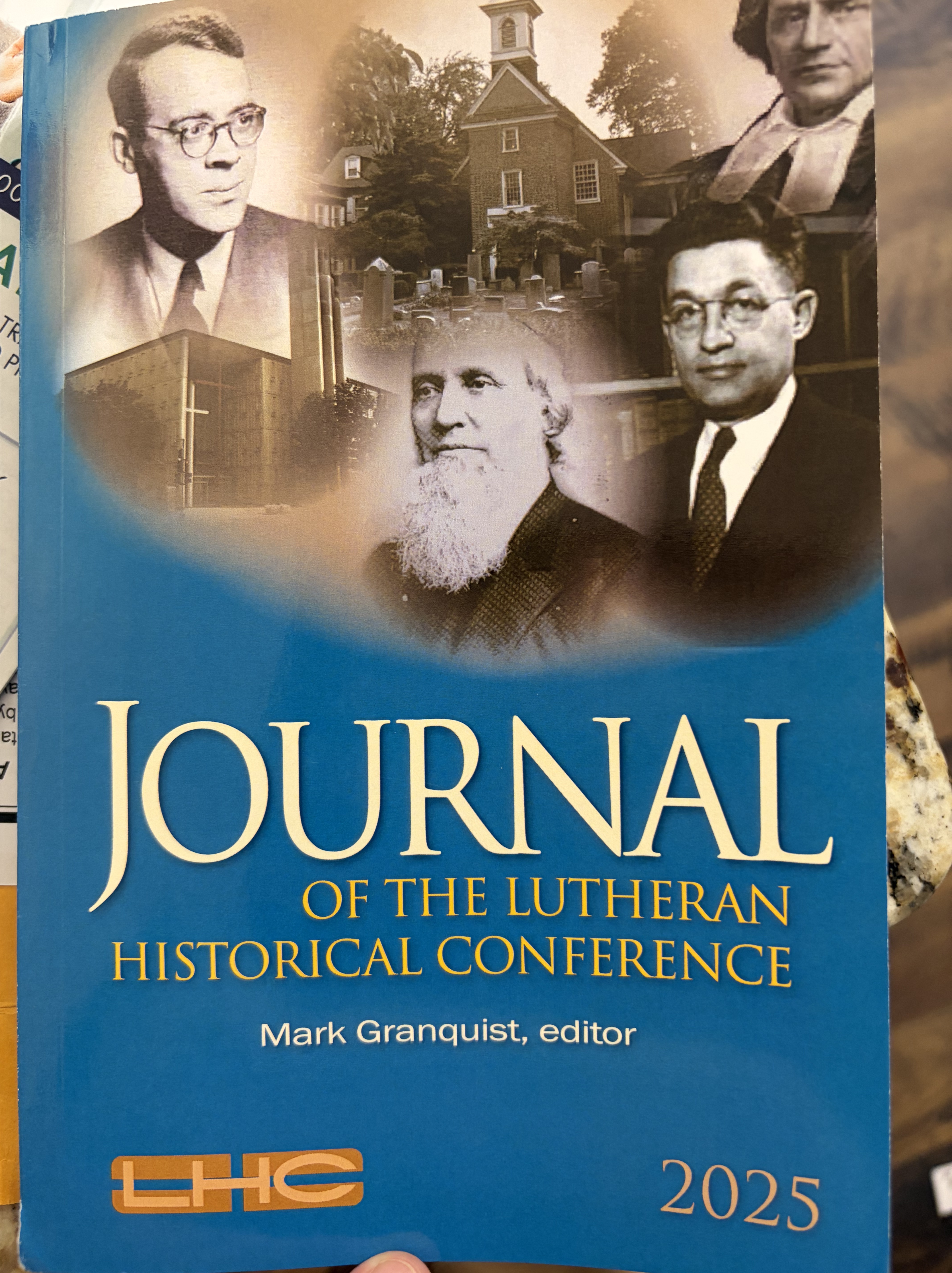
Yesterday I did have a bit of surprise and delight in receiving a hard copy of the 2025 edition of the Journal of the Lutheran Historical Conference. I had a piece accepted for publication and this was the first time I got to see it in print.
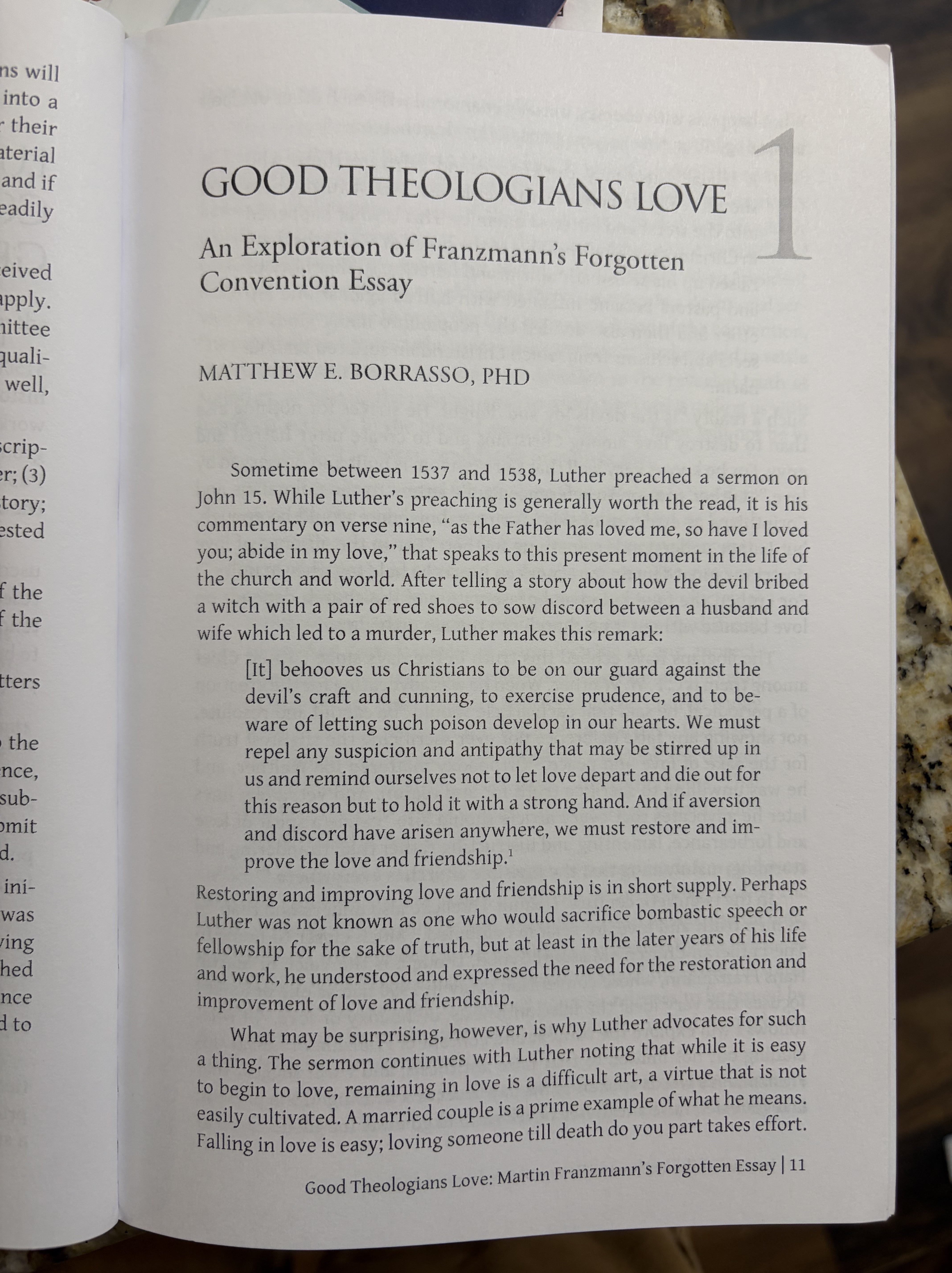
The article explores Martin Franzmann’s convention essay, based on the Letters to the Seven Churches in Revelation. He was a co-essayist and only treats the first four letters. The essay was supposed to be published but my research has yet to yield an extant copy of it. All I have is a manuscript, housed at CHI, that I’ve copied and transcribed (if you are interested in it let me know and I’ll see what I can do). The essay is great on its own, its better when you know how Behnken opened that convention. According to the convention proceedings, “he urged the delegates to be unwavering in their orthodoxy and to settle the current controversy in a spirit of devotion to the revealed truth of Scripture, to take up the mission work to which the Lord is calling us with increased activity, in the blessed assurance that our labor will not be in vain.” Why would he say that?
There is urgent reason for speaking thus. We are facing dangers. On the one hand, our generation, the third or fourth generation in our Synod’s history, no longer considers matters of doctrine so seriously as did the fathers. There is very much doctrinal complacency. There is also some doctrinal indifference. Under such conditions it is extremely difficult to awaken consciousness of pure doctrine or any appreciation of it. Any warning against false doctrine or unionism as one of the chief dangers confronting the Church today is regarded by many as the voice of an alarmist. However, the danger confronts us. Nor must we overlook the danger of separatism, legalism, lovelessness, unbrotherliness. That tends to disunite and tear apart. Unionism and separatism—one is as bad as the other.
Dangers abounded. A loss of orthodoxy, of pure doctrine. Separatism, legalism, lovelessness and unbrotherliness. The more things change, the more they stay the same.
I won’t quote too much from Franzmann but there are a few paragraphs I think are worth reading, not just for others, but for me, especially as I prepare for this convention.
In a section where he is commenting on the letter to the church in Ephesus he writes a bit more broadly.
Theologically and ecclesiologically, we are a curious generation, with a marvelous facility for drawing false distinctions, strange contrasts, and piteously inept antitheses; we contrast the nose with the face, the house with the door, and triumph in such logic as, “We ought not eat opium; therefore let us drink water.” We love to place in antithetical contrast things that should rightly be complementally conjoined; we hear such things as “evangelization or evangelical zeal,” “the old or the new,” “good hymns or hymns that people like to sing and can sing,” and even (the pity of it, fathers and brethren, the pity of it): “the Word or the Sacrament,” “the liturgy or the sermon;” and that old favorite, “the home church or the Synod” we have with us always, especially in the matter of remittances. We have not yet heard “the Old Testament or the New,” but it is probably only a matter of time.
No wonder then that the line begins to be drawn between orthodoxy and love. One can hardly imagine a more dangerous antithesis, for it rests on a misapprehension of both orthodoxy and love and can lead to a perversion of both.
When you pit orthodoxy against love, you pervert both. Are we in danger of that this week—I’d say so.
What was needed then is needed now, orthodox people in the best sense of that term.
Perhaps we had better speak, not abstractly of orthodoxy, but concretely and personally of the orthodox man; for orthodoxy is a personal and heartfelt thing… The orthodox man is the poor in spirit who faces God as He reveals Himself in His Word and his redemptive work stripped of any pretension, void of any claim, with empty hands…. He is a man before whose eyes God in His judgment and His mercy has loomed so large and so fills his whole horizon that he can see nothing and no one beside Him—God’s still small voice is, for him, louder than all the smart chatter of brisk new theologies, fire-new from the mint; louder, too, than the yowlings and yammerings of Satanic opposition. Like his Lord Jesus Christ, like the Apostles of his Lord, he cannot, will not go one step beyond a γεγραπται — “it is written” settles the business for him. His life is filled and informed and shaped by the Word of God; he moves in a strong and tense vibration between Law and Gospel, in flight from God the Judge to take refuge with God the Father of our Lord Jesus Christ. He reads Moses and the Prophets, St. James and St. Paul and hears the accents of one and the same Holy Spirit in them all, the Spirit which preceedeth from the Father and testifies of Jesus Christ. Like St. John on Patmos, he looks upon His Lord Christ and falls at His feet as one dead, feels the touch of that right hand, and hears the voice that tells him, “Fear not;” and his life is henceforth not his own but his Lord’s. Absolute submission, absolute devotion, absolute love: these are the marks of the orthodox man.
Submission, devotion, and love. These should mark all of us as we descend upon Phoenix. But, there is more to consider. In his section regarding the letters to Pergamum and Thyatira he write something else worth considering.
We are met here in His name; He is in the midst of us, when we join to sing the praise of Him who loved us and implore His grace, and when we argue, discuss, and vote to further His business. Let us remember that it is all in His presence, form the sonorous resolutions on the floor down through the freer exchange in committee to the cozy talk outside the door. He has redeemed us has redeemed us totally—our lost and broken past He has wiped out; our present and our future are not ours but His—He has redeemed us “that we might be His own, and serve Him.”
We are redeemed; we are not isolated or insulated.
The problems of Pergamum and Thyatira were as perplexing as ours: the Church then did not form a ghetto—it remained in the world and had to live and make a living there. Neither had the Church yet learned the fine but useless art of climbing atop columns and hiding in deserts. The problem of “coming out from among them and being separate” was not always simple to define nor easy to solve. The Church needed the Seer’s words, the revelation of Jesus Christ, to see where the real antithesis lay, to see that the Satanic appears not only in the imposing and monumental thrones of Satan but in a whole set of inconspicuous little Satanic ottomans that somehow get scattered among the very furniture of the Church.
The point he is making is that the attacks come from Satan and can be found everywhere. They are outside us and inside us, corporately and individually. And we must keep our eyes fixed in the right place.
What follows is how I conclude my essay, beginning with some of Franzmann’s words from his own convention essay. I hope to be surprised and delighted in more ways than one when I arrive, while I am in, and when I depart Phoenix. I know, though, that to hope for that means I have to work for that too. It isn’t just on others, it begins with me.
“I fell down at his feet as dead, says St. John the Divine, the Theologian: and so must we, if we would be good theologians and good churchmen too; for a good theologian and churchman is distinguished first and foremost by thus, that he hath an ear and heareth what the Spirit saith unto the churches, he is “quick to hear.” We must behold our Lord and die: we must die in the flatness and staleness of our convened humanity here. We must accept this Lord’s claim upon us and His judgement over us; we must measure the distance between Him and us and consider of what weight sin is; must lie prostrate at those shining feet in the beggary of the knowledge that all our ways are nothingness and all our deeds are sin. We must die as men who are, as Luther says, curved in upon themselves,—men incurvate in se, die in our self-insistence and self-sufficiency; die in the illusion that we of ourselves shall decide anything or accomplish aught in this or any convention at Milwaukee assembled. We must die that we may live. Faith is faith in God that justifieth the ungodly, in God that quickeneth the dead, and calleth those things which be not into being. No way but this, through death, to a fruitful contact with the words that the Lord Christ speaks to the churches; no way but this to life.
Assembled in Milwaukee or Phoenix, the church needs to die so that it may truly live. And life for the truly orthodox church, the church under the watchful eye of its Lord, that sees the real antithesis and offers it no quarter, is marked not by acrimony but by love.
For with repentance faith is given, and with faith love is born, the love which, like faith, is “in Christ Jesus” (Colossians 1:4); this is the love which is the coursing life in the arteries of the Church—without it eh Church forfeits its existence—“also I will come quickly, and will remove thy candlestick out of his place”—where this love fails, the Church of Him who loved us ceases to be. This is that restless love that cannot rest, that is like God (Cf. Ephesians 5:1) in that it is ever-active, seeking the other’s good. That love will do “the first works,” works that have the blush and dew of God’s new creation upon them—“If any man be in Christ, he is a new creature…behold, all things are become new.” (II Corinthians 5:17)—This love, if we let it, will do our business for us; this love will build and drive and attend our Missions; it will, it must guide and control us in matters constitutional, for unless a Constitution have this love’s impress, it is nothing worth; it will keep us from evil, for it reacts with a divinely natural and sharp reaction against all evil—it “hates the works of the Nicolatians”; it will take care of matters financial—before we are rightly aware, love works and the job is done; this love will be our sure guide in matters intersynodical; it will, it will if we but let it, settle those vexed and grievous problems at the back of the book of memorials; for this love does not cease—it does not alter when it alteration finds or bond with the remover to remove. It will do all this and more and look for no reward.
Franzmann understood the value of love not because he was wiser than the rest but because Christ grew great before his eyes and any who looks upon Christ and does not see the one who holds in himself both orthodoxy and love does not see Christ rightly. Love shapes the life of the church because love brought the church back to life.
Herein lies the some of the value of historical theology, not that it uncovers what had long since been hidden, but it calls to mind in the church of this age what it may have failed to take into account in a previous one. History speaks to the present but it does not merely tell us how to act. It gives us what we need to meet this unique moment with the voices of those who have gone before, voices heard and voices forgotten, voices that were amplified and voices that were marginalized, voices that spoke truth and truly spoke. Franzmann’s moment is not this moment, and yet Franzmann’s voice speaks to this moment because people are still people, the church is still the church, orthodoxy is still caricatured, and love is still put in antithesis to it. That is how it is, that is not how it should be, or how it has to be. The church need only look to the one who spoke once that at least twice we may hear it.
All Franzmann quotations are from his unpublished Milwaukee Convention Essay. The manuscript is available at Concordia Historical Institute.
My essay is: “Good Theologians Love: An Exploration of Franzmann’s Forgotten Convention Essay,” Journal for the Lutheran Historical Conference, 2025.

