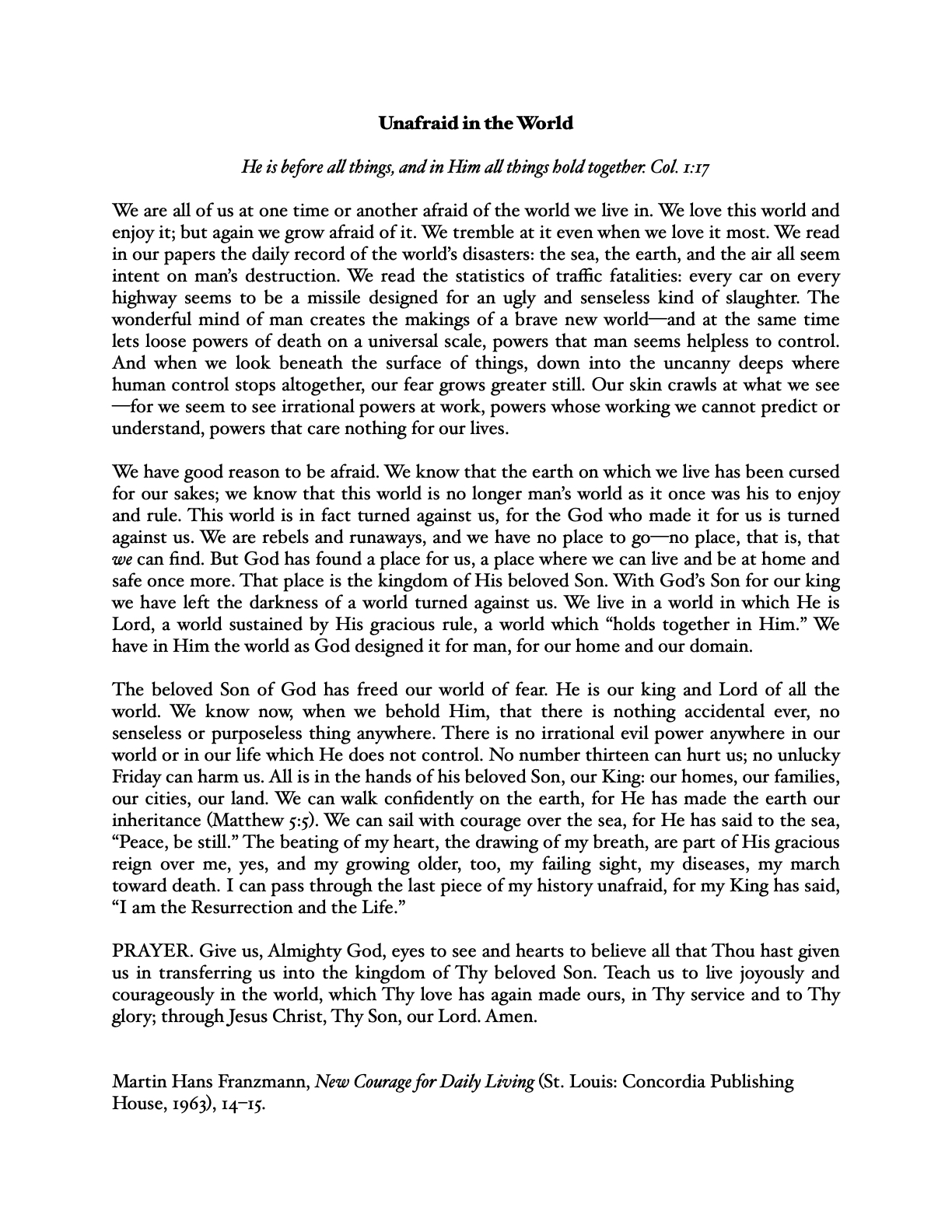
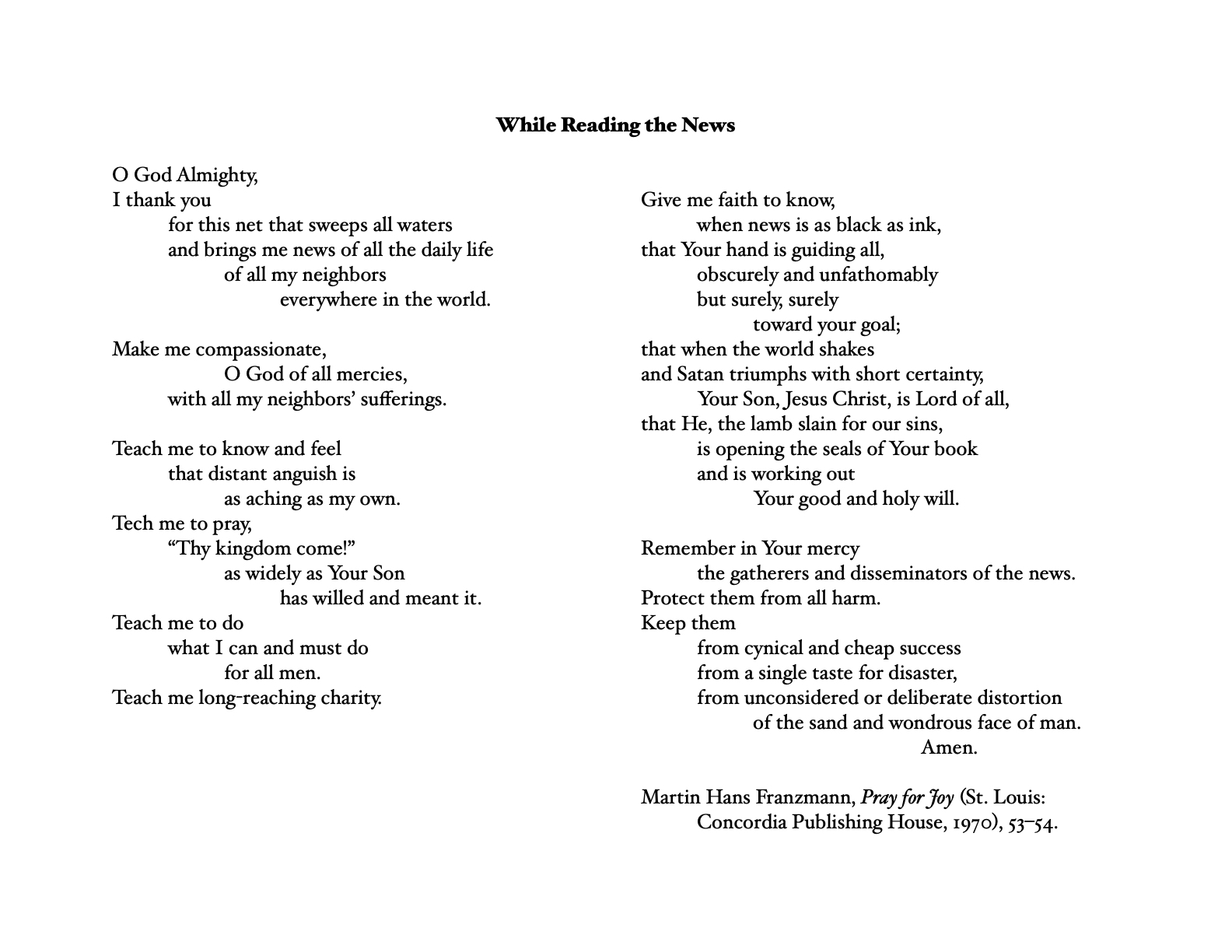
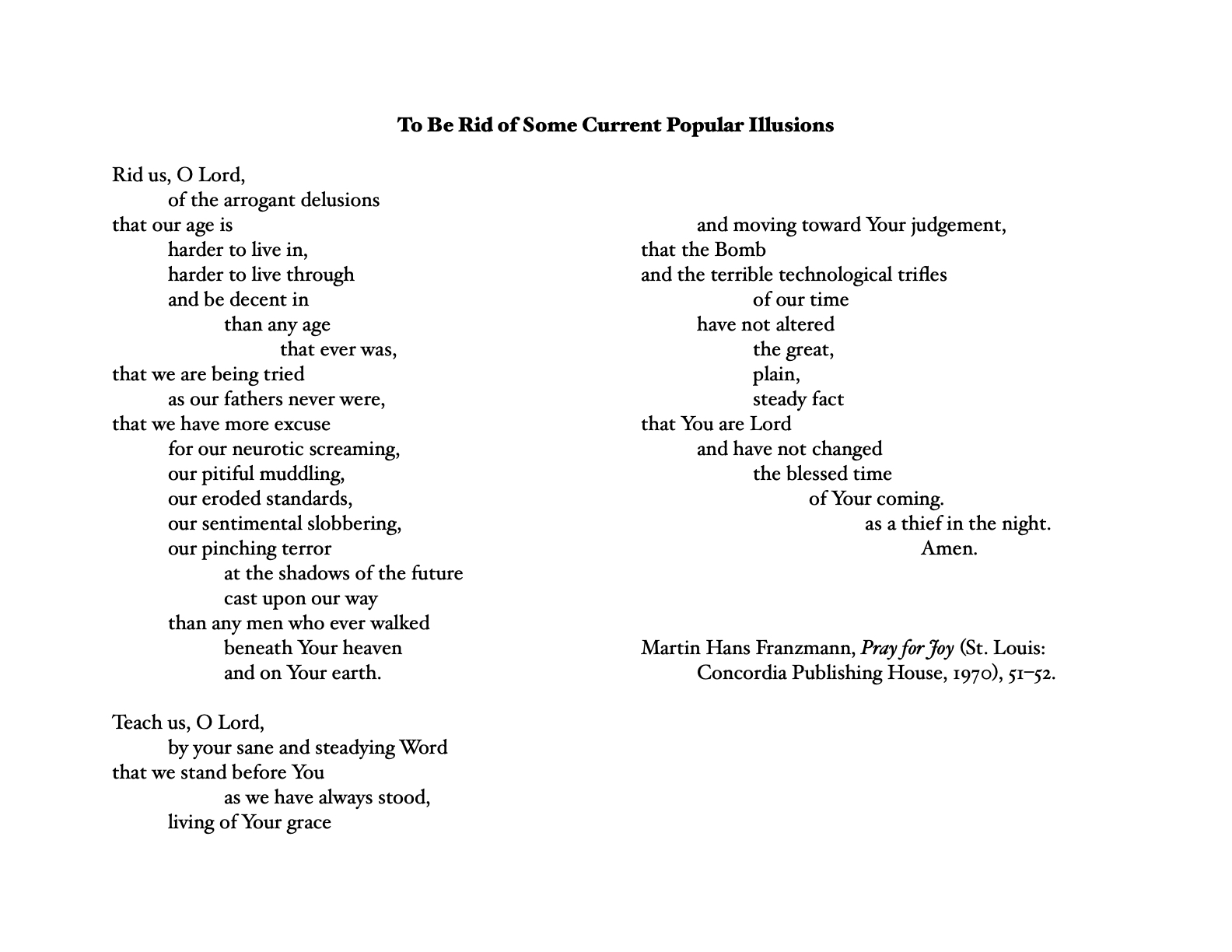
For Martin Franzmann, his wife Alice was the “lady who (saving all their lovely reverences) has made all other ladies seem a bit pale by comparison.”[1] For me, Martin Hans Franzmann is the Lutheran theologian, who, saving all their lovely reverences, has made all other Lutheran theologians, especially those named Martin, seem a bit pale by comparison. His work as a poet, hymnist, theologian, exegete, professor, and servant of the church has unfortunately faded somewhat in the years since his untimely death on March 28, 1976. Speaking at a memorial service held on the campus of Concordia Seminary in St. Louis, Prof. William Schmelder gave a description of Franzmann that is worth hearing.
For us who knew him as a teacher, he was one who opened for us the fullness and depths of the Biblical texts; who taught us as his students to emulate Moses when reading the word of God; whose posture as an interpreter was: take off your shoes, the ground on which you are standing is holy ground… If anyone had a way with words Martin Franzmann did, but always in the service of the Word. But I suppose most of all we shall remember him as a Christian gentleman, one whose teaching and preaching, whose life, whose being, whose poetry, whose elegance and eloquence had been given shape because of the death and resurrection of Jesus Christ.[2]
Indeed, Martin Franzmann was everything Prof. Schmelder suggested and more. He was someone who thought of God as one who, “makes music.”[3] Because God makes music, those authors of the biblical text were, for Franzmann, “not poets accidentally, not ‘also’ poets, but poets because they are men of God, the prophets and apostles whose word the church receives and embraces.”[4] It was misleading, thought Franzmann, “to speak of ‘poetic’ books of the Bible; the books are all poetic, for poetry is not the icing on the cake but the cake itself.”[5] Franzmann was known for his charity and kindness, for being irenic, in part because he never sought to give the “unqualified yes”[6] or the “quick and easy answer,” in part because he understood that “unfairness toward seriously searching men is not a virtue.”[7]It is my intention on the anniversary of his death to reacquaint you with the Lutheran theologian who I hope will become for you too, the Lutheran theologian who will make others seem a bit pale by comparison. Below are a few of his writings I commend to you, not only because they speak to our time, but because they show that the powers of this age are a bit pale by comparison to the one who sits enthroned above all.
[1] Martin Hans Franzmann, “Of a Man and Four Rivers,” British Lutheran 14, no. 8 (October 1969): 6.
[2] William Schmelder, Memorial Service for Martin Franzmann, Concordia Seminary, St. Louis, MO, April 2, 1976. Robin Leaver, also quotes this in his introduction using Fred L. Precht, Lutheran Worship Hymnal Companion (St. Louis: Concordia Publishing House, 1992), 609; Robin Leaver, Come to the Feast: The Original and Translated Hymns of Martin H. Franzmann (St. Louis: MorningStar Music Publishers, 1994), 20. The audio recording of Prof. Schmelder’s message still exists in the archives of Concordia Seminary in St. Louis. The quote above has been rendered to match the audio recording as opposed to the transcription used in Precht and Leaver. While the difference is minimal, it should be noted.
[3] Martin Hans Franzmann, “The Devil Has All the Good Tunes,” in Robin Leaver, Come to the Feast: The Original and Translated Hymns of Martin H. Franzmann (St. Louis: MorningStar Music Publishers, 1994), 127.
[4] Franzmann, “The Devil Has All the Good Tunes,” 127.
[5] Franzmann, “The Devil Has All the Good Tunes,” 127.
[6] Martin Hans Franzmann, “A Brief Statement: Exegetical Aspects,” 2. Unpublished manuscript at Concordia Historical Institute.
[7] Martin Hans Franzmann, “Lutheran Church—Missouri Synod, 125th Anniversary, 1972,” 9. Unpublished manuscript at Concordia Historical Institute, 1972.
 an occasional theologian